CEO Brief: Reflections from EAGE 2026: Where Now for Exploration? How Do We Replace the Reserves the World Needs?
It was an energising week in Aberdeen for the EAGE (European Association of Geoscientists and Engineers) Annual 2026 where we had the opportunity to engage with the global geosciences community under the warm glow of the hospitality of the EAGE team and the city of Aberdeen. Frontier enjoyed hosting our clients, members and invited guests throughout the week at the Global Upstream Leaders Reception and at the Senior Executive Management programme. I also had the pleasure of moderating a fabulous panel on the Strategic Stage and I thought it was worth sharing some of the outcomes of this panel as it aimed to answer a question central to our industry;
Where Now for Exploration? How Do We Replace the Reserves the World Needs?
The session brought together Dr Bryan Ritchie (bp), Nicola Mavilla (TotalEnergies), Mohammed Duhailan (aramco), David Hajovsky( TGS) and Henning Berg (Viridien) for an honest discussion on the future of exploration. We covered geology of course, but a wider conversation transpired about security, technology, government policy, capital and the industry's ability to continue replacing reserves in an increasingly competitive and challenging environment.
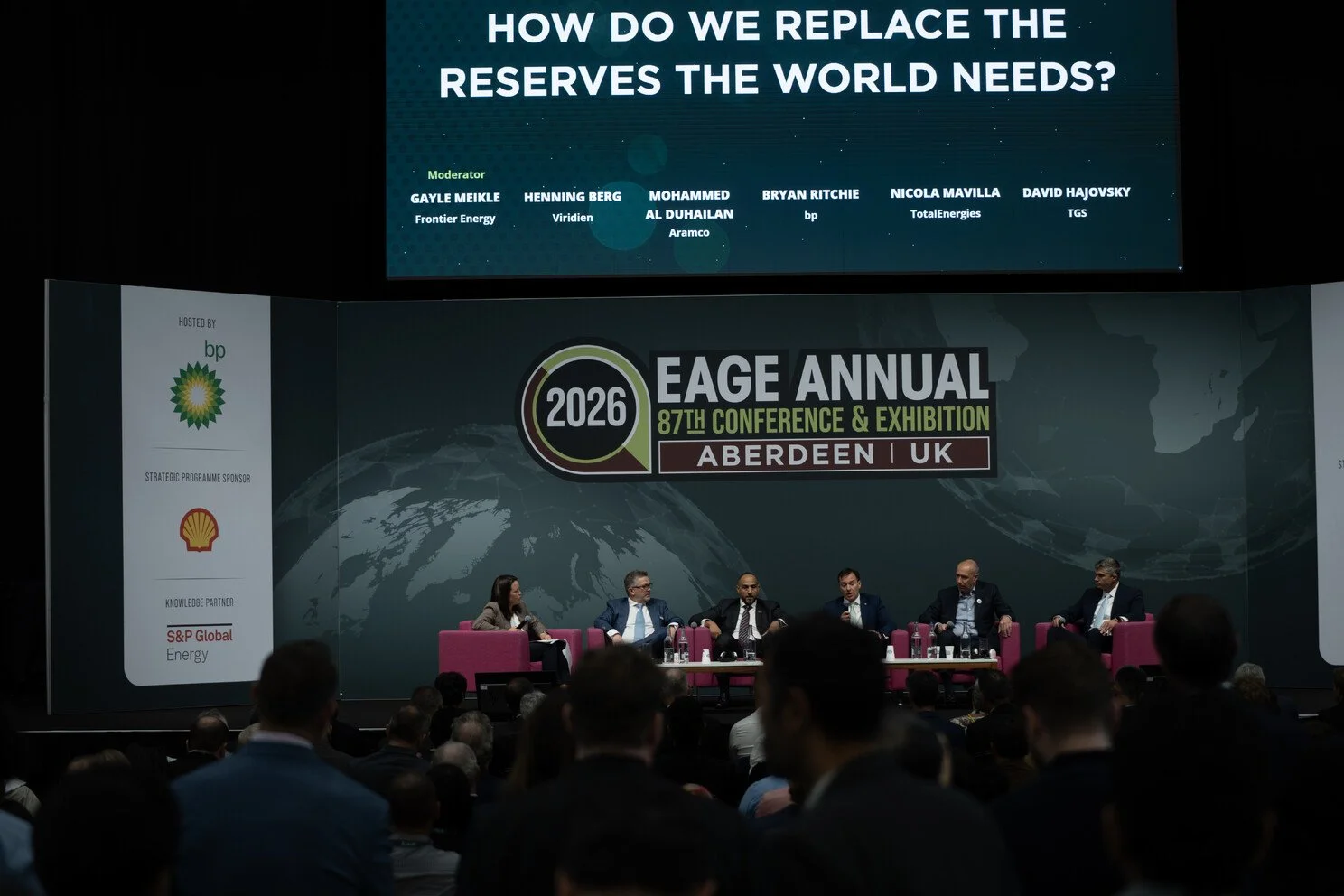
A Changing World Creates a Greater Need for Exploration
The discussion opened with the observation that many of the industry's challenges have existed for decades, but that security concerns have now become an additional factor shaping investment decisions. The uncertainty surrounding global supply capacity, particularly in the Middle East, has reinforced the importance of finding new resources.
Bryan Ritchie argued that this changing environment should increase the industry's focus on exploration. New discoveries will be required not only in frontier regions but also within existing producing basins if future energy demand is to be met. He noted that exploration today is influenced by far more than geology alone. Fiscal terms, government support, regulatory certainty and speed of execution increasingly determine where capital is deployed. One of Bryan's strongest observations was that there are many examples around the world where similar geological opportunities exist on either side of a border, yet investment activity differs dramatically because of differences in policy, licensing systems and government support.
The challenge is no longer simply finding hydrocarbons. It is creating the conditions that allow investment to flow towards them.
Exploration is About More Than Rocks
Building on this theme, Mohammed Al Duhailan observed that exploration looks very different depending on where you sit. From Saudi Arabia's perspective, many countries have significantly improved their fiscal terms and investment frameworks over the past fifteen years, creating opportunities that would previously have struggled to attract capital. At the same time, he acknowledged that the industry is operating in a world where a significant proportion of conventional resources have already been discovered. The challenge is therefore becoming less about finding obvious opportunities and more about understanding where the remaining potential lies.
Bryan Ritchie agreed, noting that successful exploration increasingly requires multiple factors to align. Great geology alone is no longer enough. Governments must provide supportive policies, fiscal frameworks must be competitive, capital must be available and companies must be able to move quickly.
Exploration success today depends on both below-ground and above-ground excellence.
Technology is Transforming Exploration
Technology emerged as one of the dominant themes throughout the discussion.
David Hajovsky explained that advances in acquisition and imaging technologies are helping operators reduce risk, improve the probability of success and accelerate decision-making. The industry's focus, he argued, remains centred on reducing cycle times and enabling companies to make better decisions earlier in the exploration process. Bryan Ritchie pointed to the Gulf of America as a powerful example of how seismic technology has evolved. Modern ocean-bottom seismic data is revealing targets that were simply not visible fifteen years ago. New datasets are changing geological understanding and creating opportunities that would previously have been overlooked. The panel agreed that better data is going beyond improving images; it is changing investment decisions.
Technology is no longer just improving exploration outcomes. It is fundamentally changing what the industry is able to see and pursue.
Understanding Uncertainty Creates Value
One of the more thought-provoking contributions came from Mohammed Al Duhailan, who challenged the industry's traditional approach to uncertainty. He argued that exploration teams often treat uncertainty as a liability that must be eliminated. In reality, he suggested, the value of subsurface work lies in understanding and quantifying uncertainty rather than simply attempting to remove it. This perspective led into a broader discussion around the future of subsurface interpretation and how technology can help companies make better decisions in increasingly complex geological settings.
The industry's competitive advantage may increasingly come from understanding uncertainty better than its competitors.
AI, High-Performance Computing and the Next Frontier
The conversation naturally moved towards artificial intelligence and advanced computing. Henning Berg explained that technologies such as Full Waveform Inversion have existed for many years, but recent advances in high-performance computing have unlocked their full potential. The industry's objective remains: create the best possible subsurface image before drilling. What has changed is the scale and speed at which this can now be achieved. Mohammed Al Duhailan provided one of the most compelling examples discussed during the session. He described how Aramco is combining AI-driven interpretation, integrated basin modelling and proprietary simulation technologies to analyse billions of cells across millions of square kilometres. This work is helping identify new plays, validate prospectivity and improve understanding of hydrocarbon systems across the Kingdom. Meanwhile, Nicola Mavilla stressed that technology alone is not enough. It must be embedded within organisations in a way that allows people to generate new ideas and improve decision-making.
AI and computing power are becoming major competitive advantages, but they remain most effective when combined with human expertise and geological insight.
Governments Matter More Than Ever
Government policy and investment frameworks featured prominently throughout the discussion. Bryan Ritchie highlighted several examples where strong government engagement had directly accelerated exploration activity, including recent experiences in the Gulf of America, Egypt and Gabon. Governments that move quickly and engage constructively create opportunities for companies to move quickly as well. Henning Berg reinforced the importance of transparency and predictability. He pointed to Norway and the Gulf of America as examples where companies have confidence in licensing systems, fiscal terms and regulatory stability. Nicola Mavilla added that responsiveness is often just as important as fiscal competitiveness. Countries that cannot respond quickly to investor proposals risk losing capital to more agile jurisdictions.
In today's market, governments compete for exploration capital just as aggressively as companies compete for acreage.
The Debate of the Session: Are MOUs Becoming a New Land Grab?
One of the most animated moments of the discussion centred on the growing use of Memoranda of Understanding (MOUs) as a route into prospective acreage. The debate exposed a genuine difference of perspective between operators and the geophysical sector.
Bryan Ritchie rejected suggestions that MOUs represent a simple "land grab". He argued that for bp they are a practical mechanism for accessing data, evaluating opportunities and building future portfolios. Using examples such as Gabon, he explained how MOUs allow companies to begin technical work quickly and assess opportunities before committing significant capital. From the service-company perspective, David Hajovsky highlighted a different challenge. Competitive licensing rounds have traditionally supported investment in multi-client seismic programmes. When large areas are tied up under MOUs for extended periods, visibility can be reduced and planning future investment becomes more difficult. Nicola Mavilla sought to bridge the two positions, arguing that MOUs can be highly effective provided they are used to evaluate opportunities and move projects forward within a reasonable timeframe.
The discussion revealed a broader industry tension between accelerating access to acreage and maintaining the competitive processes that have historically driven exploration investment.
MOUs can accelerate exploration, but only if they lead quickly to technical work, investment and drilling rather than simply removing acreage from the market.
Capital Discipline is Here to Stay
The panel agreed that capital discipline has become a permanent feature of the industry. Henning Berg argued that discipline and growth are not mutually exclusive. Better data, better understanding and higher exploration success rates allow companies to remain disciplined while continuing to invest in future opportunities. Bryan Ritchie noted that exploration budgets must compete with many other investment opportunities within large organisations. Exploration therefore has to demonstrate that it can generate superior value. This led to one of the most memorable concepts introduced during the discussion. David Hajovsky described what he called the exploration investment flywheel. Successful discoveries create credibility. Credibility attracts investment. Investment creates future opportunities and future discoveries. The panel broadly agreed that if the industry wants to increase exploration spending, investors must be willing to reward successful exploration outcomes.
Exploration will continue to compete for capital, making success rates and value creation more important than ever.
Where Will the Next Reserves Come From?
Looking ahead, the panel identified several regions generating significant excitement. Bryan Ritchie highlighted the Gulf of America, Namibia and other frontier opportunities capable of delivering material discoveries. Nicola Mavilla pointed to Namibia, South Africa, Papua New Guinea and Malaysia, while also stressing the importance of exploration around existing production hubs. David Hajovsky highlighted continued investment across the Atlantic Margins, including Brazil, Angola and Nigeria, alongside growing activity in frontier areas. Henning Berg identified Brazil, Norway and the US Gulf as key areas of continued focus for Viridien. Mohammed Al Duhailan pointed to deep Palaeozoic gas opportunities and unconventional resource development as central to Saudi Arabia's future exploration strategy.
The industry's future reserve base is likely to come from a combination of frontier basins, deeper plays, gas resources and opportunities unlocked by new technology.
Final Reflections: What Gives the Industry Optimism?
As the discussion drew to a close, the panel reflected on what gives them confidence for the future. Nicola Mavilla argued that exploration remains fundamentally about ideas and that the industry must avoid repeatedly switching exploration on and off if it wants to sustain future success. Bryan Ritchie highlighted collaboration as an increasingly important driver of future exploration success. Mohammed Al Duhailan stressed the importance of protecting and developing talent, warning that the industry's technical capability is gradually being eroded. Henning Berg pointed to the opportunities created by new technologies and better data. David Hajovsky emphasised the industry's resilience and its ability to continually overcome challenges through innovation and adaptation.
Final Takeaway
After an hour of debate and good humour, the panel reached a clear conclusion: exploration remains essential, but the rules of the game are changing. The feeling was that success will depend on combining technology, data, government support, capital discipline, talent and collaboration. The geology may not have changed, but the way the industry competes for and develops opportunity is a movable and changing picture.

I look forward to exploring these themes and more at the World Energies Summit | The World’s Premier Global Upstream Conference | 29th - 30th September 2026 where upstream leaders will gather to meet, collaborate and get deals done.